
7 Offering Memorandum Template Mistakes to Avoid
3 Jun, 2026
You finally finish the deal.
The photos look great. Location checks every box. Numbers make sense. You package everything together, hit send, and wait for investor calls to roll in.
Then nothing happens.
No replies. No questions. No serious interest.
Most brokers blame the market. Some blame interest rates. Others blame investors.
But many times, the problem sits right inside the offering memorandum template itself.
A great property can lose attention when the story feels messy, confusing, or incomplete. Real estate investors review dozens of deals every month. They don't have time to dig through clutter and guess why your property deserves attention.
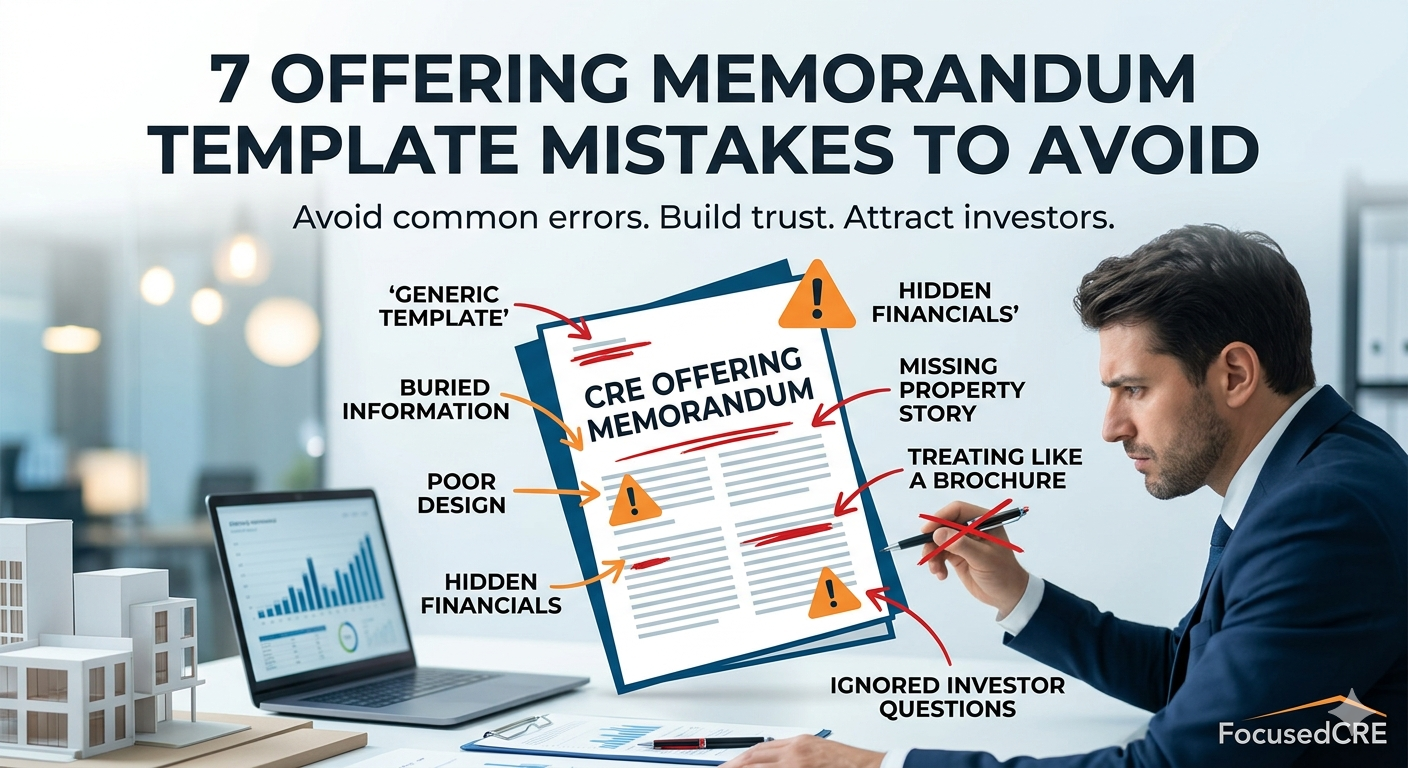
Let's look at seven common mistakes that push investors away.
Mistake 1 – Using a Generic Offering Memorandum Template
Many brokers search for a free offering memorandum template and call it a day.
That shortcut often creates problems.
A generic template rarely fits the property, the audience, or the investment story. Investors notice when a document looks like every other deal sitting in their inbox.
Your offering memorandum templates don’t have to be the most popular. But they should at least portray your opportunity uniquely. A strong offering memorandum template should support the property, not overpower it.
The same rule applies if you use free real estate offering memorandum template, a commercial real estate offering memorandum template free download, or a custom-built design.
Template provides the structure. And the deal provides the story.
Mistake 2 – Burying the Best Information
Think about how investors read.
Most people imagine investors starting on page one and carefully reading every word. That rarely happens. Because they scan first. And hunt for answers.
They want to know:
That means your executive summary and investment highlights carry enormous weight. And when these sections feel weak, investors often lose interest before they reach the property financials.
A strong investment package immediately explains the opportunity. An effective investor presentation doesn't force people to search for important information. It puts the most valuable details right in front of them.
Mistake 3 – Ignoring Offering Memorandum Design
An average broker may treat design as decoration. But investors treat it as a trust signal.
Imagine walking into two restaurants. One looks clean, organized, and welcoming. The other looks cluttered and neglected. You already feel different before you taste the food.
The same thing happens with offering memorandum design.
Poor spacing, crowded pages, tiny fonts, and weak visuals = friction.
Good design creates momentum.
Strong CRE marketing materials guide the reader naturally from one section to the next. The best property brochure designs feel effortless because they remove distractions.
Investors should focus on the deal instead of fighting the layout.
Mistake 4 – Hiding Important Financial Information
Nothing frustrates investors faster than incomplete numbers.
Many brokers spend pages discussing demographics, local attractions, and market trends but barely explain the property's actual performance.
Commercial Real estate investors want clarity.
They want property financials, net operating income, cap rate information, rent roll details, and evidence. Every investment opportunity lives and dies by numbers.
Strong due diligence starts with transparency.
If investors are emailing you for basic information, your OM already lost momentum. Because property financial analysis should feel simple, direct, and easy to understand. Easier the decision process → easier the investor engagement.
Mistake 5 – Forgetting the Property Story
Numbers matter. But stories move people.
Many offering memorandums feel like giant spreadsheets wrapped inside a PDF. But investors buy outcomes.
Every property has a story. Maybe a new development transforms the area. Maybe a growing employer drives demand. Maybe the asset sits in a supply-constrained market. Maybe below-market rents create upside potential.
Your asset overview should connect the dots.
Your market analysis should explain why the opportunity exists.
Your tenant overview should reinforce stability and growth potential.
The best deal marketing materials show investors a clear future before they analyze the numbers.
Mistake 6 – Treating an OM Like a Brochure
Many people confuse an Offering Memorandum (OM) with a marketing flyer.
They serve different purposes.
A brochure grabs attention.
An OM builds conviction.
A brochure introduces the property.
An acquisition package helps investors evaluate it.
A brochure may include photos and headlines.
An OM includes investment highlights, financials, market data, tenant information, and due diligence material.
When brokers treat an OM like a simple property brochure, investors leave with more questions than answers. That creates uncertainty. And uncertainty kills momentum.
Offering Memorandum vs. Brochure – What's the Difference?
A brochure:
- Focuses on promotion.
- Highlights features.
- Starts conversations.
An Offering Memorandum
- Focuses on decision-making.
- Explains risk, opportunity, performance, and strategy.
- Moves conversations toward offers.
That's why serious commercial real estate marketing relies on both tools.
Mistake 7 – Ignoring Investor Questions
Every investor asks questions.
The best OMs answer those questions before anyone picks up the phone.
Strong investor relations starts with anticipation. So, think about what they want to know.
- What risks exist?
- Why is the owner selling?
- What creates future value?
- What makes this investment different?
- What assumptions support the projections?
- Every unanswered question creates resistance.
Every answered question builds trust.
A great investment memorandum feels like a conversation with an experienced advisor. It removes confusion before confusion appears.
What Should Be Included in an Offering Memorandum?
A complete Offering Memorandum should include:
- Executive Summary
- Investment Highlights
- Asset Overview
- Market Analysis
- Tenant Overview
- Property Financials
- Rent Roll
- Due Diligence Information
- Investment Strategy
- Risk Factors
- Contact Information
These sections create a complete picture for investors.
So, if you review an offering memorandum example, sample offering memorandum, example of offering memorandum, or investment memorandum example, you'll notice that successful documents follow a similar structure.
How to Write an Offering Memorandum That Sells Your Property
And if you’re confused, reach out to FocusedCRE for professional OMs. Because clarity beats complexity every time.
Examples and Templates Investors Expect to See
Many professionals study an investment memorandum sample before building their own document. Others start with a real estate investment memo template or an investment memorandum template to speed up production.
Some review a real estate investment memo example to understand layout and structure as well.
Capital raising teams often examine a private placement memorandum example, a ppm private placement memorandum template, or a private placement memorandum template real estate package.
Private equity firms frequently reference a private equity offering memorandum sample.
Marketing teams may begin with an offering memorandum PowerPoint template before converting it into a polished PDF.
Some firms also use an operating memorandum template during internal planning.
Templates save time. Examples provide direction. Neither replaces strategy.
The strongest OMs combine structure, storytelling, design, and data into a single investor-focused experience. And that’s what we do for a living at FocusedCRE.
Frequently Asked Questions
1. What is an offering memorandum template?
An offering memorandum template provides a framework for organizing property information, financials, market data, and investment highlights for potential investors.
2. What should an offering memorandum include?
It should include an executive summary, property overview, financials, rent roll, market analysis, tenant information, and due diligence materials.
3. How long should an offering memorandum be?
Most commercial real estate OMs range from 15 to 50 pages depending on asset size, complexity, and investor requirements.
4. What is the difference between an OM and a PPM?
An OM focuses on marketing an investment opportunity. A Private Placement Memorandum (PPM) focuses on legal disclosures and fundraising documentation.
5. Can I use a free offering memorandum template?
Yes, but many free templates lack the structure, design quality, and flexibility needed to support professional CRE transactions.
Final Thoughts
A great property deserves more than a generic offering memorandum template.
When investors open your document, they should immediately understand the opportunity, trust the information, and see the path to value.
- Avoid generic templates.
- Lead with strong investment highlights.
- Improve your offering memorandum design.
- Present property financials clearly.
- Tell a compelling story.
- Answer investor’s questions.
- Build confidence on every page.
Do that consistently, and your offering memorandum won't just share information. It will help sell the opportunity behind it.
And if you want to avoid mistakes, reach out to us (FocusedCRE) for professional assistance.